L1 Immigration Attorney Support
In today's global chess game of international commerce, the capability to place the right talent in the right location at the optimal time is a crucial advantage. For multinational organizations, the L-1B visa acts as a professional's copyright-an essential tool for relocating employees with specialized expertise to the United States. This visa classification is specifically designed for professionals who maintain "specialized knowledge" that is essential to the firm's activities, products, or services. However, the term "specialized knowledge" remains one of the most complex and closely examined aspects in U.S. immigration law. This resource aims to clarify the L-1B visa, offering a strategic roadmap for organizations and professionals looking to leverage this valuable pathway. With the guidance of a seasoned L1 immigration attorney, the L-1B visa can create new avenues for growth and innovation in the American market.
Essential Points
- The L-1B visa is a non-immigrant visa for staff members with L-1B specialized knowledge that is essential for an organization's operations.
- It stands as a key component of the multinational company transfer process, empowering enterprises to maximize their internal workforce for operations in the United States.
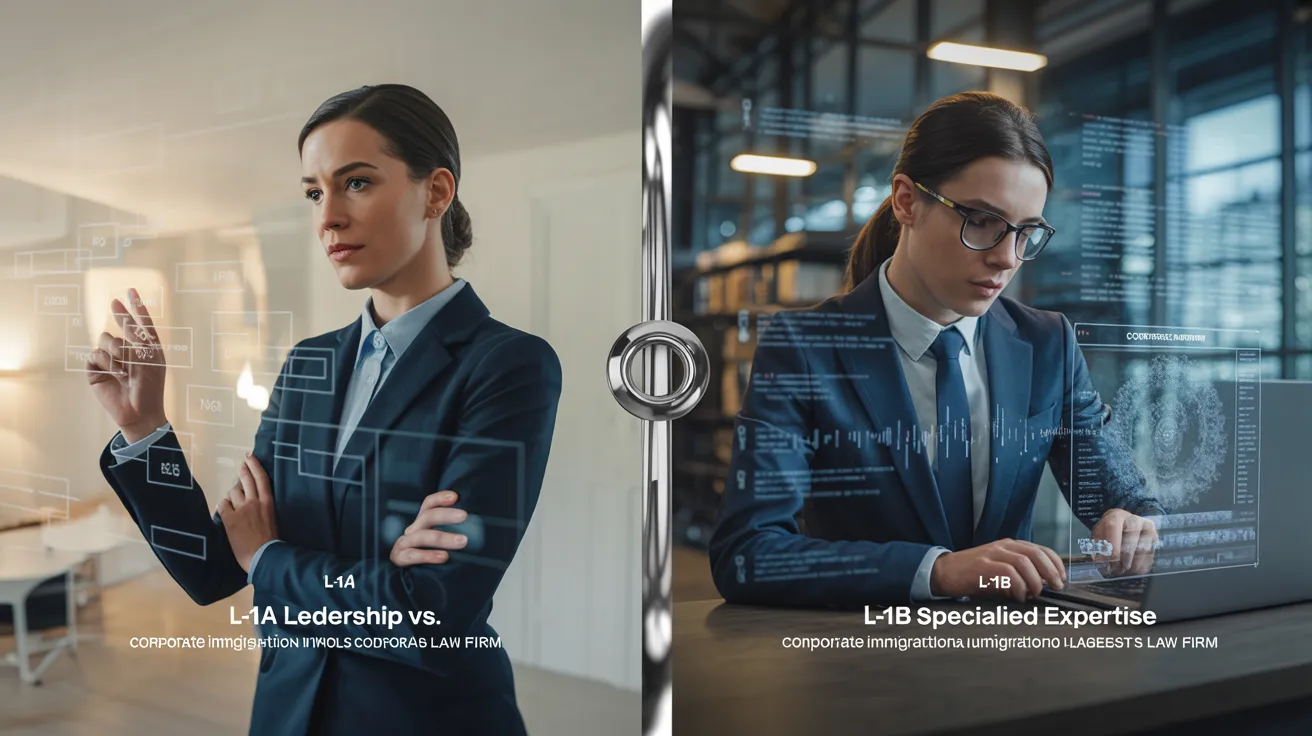
- In contrast to the executive transfer visa (L-1A), the L-1B highlights an employee's unique skills and expertise as opposed to their management responsibilities.
- Demonstrating expert proficiency is a significant evidentiary standard, establishing the support of an L1 visa lawyer essential for building a strong application.
- An experienced L1 immigration attorney serves as your key advantage when handling the challenges of L-1B visa processing, especially when handling challenging Requests for Evidence (RFEs).
- Even though the L-1B includes a five-year maximum, it can act as a route to a copyright, and an legal expert can help strategizing for this long-term objective.
Navigating Global Business: The Essential Guide to Multinational Company Transfers
The L-1 visa system operates as the foundation of global business, enabling the seamless movement of talent for a multinational company transfer. It enables organizations to relocate crucial employees from their overseas locations to a parent, subsidiary, affiliate, or branch office in the United States. This corporate relocation process is essential for preserving corporate culture, conveying institutional knowledge, and executing global business strategies. The L-1 visa comprises two unique categories: the L-1A for managers and executives, and the L-1B for specialists with unique expertise. While both categories support the larger goal of enabling international business, they have different qualification requirements and strategic impacts. Comprehending the intricacies of this program is essential for any company seeking to grow its footprint in the U.S., and it's a journey best managed with the counsel of an experienced immigration lawyer.
The Foundation of Your Application: Understanding L-1B Advanced Knowledge
The basis for any L-1B visa petition rests on a single, crucial, and often complex concept: L-1B specialized knowledge. This definition is not straightforward, and its interpretation by U.S. Citizenship and Immigration Services (USCIS) has evolved over time. As defined by USCIS, specialized knowledge is defined as expertise held by a person that is exceptional and particular to the sponsoring company's products, services, research, equipment, techniques, management, or other interests. It represents knowledge that is not widely available within the industry or that isn't readily teachable to another individual without significant cost or business disruption. Demonstrating the existence of specialized knowledge must satisfy a high evidentiary threshold. It requires a thorough click here and persuasive demonstration that the employee's skills and expertise are genuinely distinctive, exclusive, and crucial to the company's U.S. operations. This is where the expertise of an L1 visa lawyer is crucial in building a convincing and comprehensive case.
The Executive Transfer Visa (L-1A): A Comprehensive Overview
To fully understand the distinct characteristics of the L-1B visa, it's valuable to compare it with its executive counterpart, the L-1A visa. The L-1A is an executive transfer visa intended for managers and executives who will be directing the management of the organization or a major function. The primary concern of the L-1A is on the individual's senior-level managerial or executive duties and their power to determine outcomes and direct the work of others. In contrast, the L-1B focuses on the uniqueness and depth of the individual's knowledge, regardless of their position in the corporate hierarchy. While an L-1A beneficiary leads the team, the L-1B beneficiary is usually the crucial technical expert or specialist on that team. Grasping this differentiation is vital for determining the correct visa category and for building a successful petition, as the proof requirements for each are substantially different.
Creating an Ironclad Case: How an L1 Visa Lawyer Proves Specialized Knowledge
Proving the existence of L-1B specialized knowledge requires both creativity and precision, and it should be handled by a skilled L1 visa lawyer. A winning petition requires solid documentation founded upon comprehensive conclusive evidence and strong legal justification. An experienced lawyer partners closely with the company and the employee to identify and articulate the specific knowledge that makes the employee unique. This involves a comprehensive review of the organization's unique methods, systems, and operational procedures. The lawyer will then gather a wide range of supporting materials to support the claim, which could encompass proprietary documents, training manuals, project reports, and management endorsements. The objective is to create a clear and compelling case for the USCIS adjudicator, proving that the employee's knowledge is more than beneficial, but absolutely crucial to the U.S. operation's growth. This meticulous case-building is the hallmark of a leading L1 immigration practice.
Navigating Success: A Step-by-Step L-1B Application Guide
Managing the L-1B application process is similar to using a detailed blueprint for success. With the assistance of an L1 immigration attorney, the process can be organized into a series of systematic steps. It initiates with a complete eligibility assessment of both the company and the employee. This is proceeded by the strategic preparation of the petition, which includes the collection of all necessary documentation and the creation of the legal arguments. Once the petition is registered with USCIS, there is a period of adjudication, during which the government evaluates the case. If USCIS demands additional information, they will provide a Request for Evidence (RFE), which must be handled in a swift and complete manner. Upon validation of the petition, the employee can then seek their L-1B visa at a U.S. consulate or embassy abroad. The last phase is the visa interview, after which the employee can enter the U.S. and initiate their assignment.
Navigating Immigration Complexity: How an L1 Attorney Serves as Your Guide
America's immigration framework stands as a complex and often unforgiving bureaucracy. An L1 immigration attorney acts as your advocate, your guide, and your champion in this framework. Their role is not just to file paperwork; they deliver expert guidance and to identify and address possible challenges. From beginning consultation through final visa determination, a seasoned legal professional will guide you, making certain your application is optimally positioned. They will guide you through the complex legal requirements, ready you for immigration officer review, and handle any issues that develop. In a system where a single mistake or omission can lead to costly delays or even a denial, the value of a dedicated legal advocate cannot be overstated.
Overcoming Hurdles: RFEs and Denials
Receiving a Request for Evidence (RFE) or rejection on an L-1B petition is often a major setback, but it's not necessarily the end of the road. This marks a vital moment where the guidance of an L1 immigration attorney is especially important. An skilled attorney will thoroughly examine the RFE or denial notice to identify the government's rationale and to identify the specific areas of concern. They will then partner with you to formulate a strategy for responding to the RFE or for contesting or filing again the case in the event of a denial. A well-crafted RFE response or appeal requires not just additional evidence, but also a compelling legal argument that directly addresses the government's concerns. With the proper legal strategy, it is frequently achievable to overcome these obstacles and secure a successful outcome.
Exploring the Blanket L-1: A Streamlined Process for Qualified Businesses
For large, established multinational corporations, the Blanket L-1 program delivers a straightforward and productive option for relocating employees to the United States. Once a company has an approved Blanket L petition, it can transfer employees, including those with L-1B specialized knowledge, without needing to file a separate application with USCIS for each employee. Rather, the employee can apply for their L-1B visa straight at a U.S. embassy or consulate abroad. This substantially decreases processing times and administrative burdens. To qualify for the Blanket L program, a company must satisfy certain operational and scale criteria. An experienced L1 visa lawyer can advise a company on their qualification status for this program and can help with the preparation and filing of the Blanket L petition.
Life in America: Understanding L-1B Status Rights and Restrictions
Residing in the United States on an L-1B visa features a distinct set of rights and limitations. The primary right is the ability to live and work in the U.S. for the petitioning employer. L-1B visa holders may also bring their spouse and unmarried children under 21 with them on L-2 dependent visas. A significant benefit is that L-2 spouses are eligible to apply for work authorization, permitting them to work for any employer in the U.S. However, there are also constraints. The L-1B visa has a cap of five years, and when this duration ends, the individual must usually depart the U.S. for at least one year before they can be eligible for a new L or H visa. It is also essential to remember that the L-1B is a non-immigrant visa, and holders must preserve an intent to leave the U.S. upon the end of their status.
From Specialist to Resident: Pathways to a copyright for L-1B Holders
Even though the L-1B visa functions as a temporary, non-immigrant visa, it operates as a valuable stepping stone from specialist to resident. Many L-1B holders, the primary objective is to secure permanent residency (a copyright) in the United States. Although the L-1B lacks a direct path to a copyright comparable to the executive transfer visa (L-1A) features, there are still viable pathways. An L-1B holder can potentially qualify for a copyright through the PERM labor certification process, where their employer supports them for permanent residency. As another option, if the L-1B holder transitions to a managerial or executive position, they may become eligible to submit for a copyright under the EB-1C category. An experienced L1 immigration attorney offers crucial strategic guidance on the best pathway to a copyright considering the individual's specific situation and career trajectory.
Popular Questions
What defines L-1B specialized knowledge under the law?
The official interpretation of L-1B specialized knowledge is intricate and open to interpretation by USCIS. It is defined as knowledge that is specialized and unique to the petitioning organization's products, technologies, procedures, systems, management practices, or core competencies. This knowledge must be distinct from what is generally known within the industry and that cannot be easily transferred to another individual without significant expense or inconvenience. Establishing that an employee's skills fulfill these criteria calls for thorough documentation and an in-depth analysis of why their skills are distinctive and vital to the company. An L1 visa lawyer is vital for constructing a case that successfully proves this qualification.
What makes the L-1B visa distinct from the H-1B visa?
The L-1B and H-1B visas are both non-immigrant work permits, but they differ in several crucial aspects. As an intracompany transfer visa, the L-1B requires the employee to have maintained employment with a related foreign entity for one year or more before transferring to the U.S. The H-1B visa caters to professionals in specialized fields and does not necessitate prior employment with a related foreign company. The H-1B is subject to an annual cap, making it a lottery-based system, while the L-1B isn't subject to annual quotas. For the L-1B, specialized company-specific knowledge is essential, while the H-1B demands a bachelor's degree or its equivalent in a specific field.
Am I allowed to transfer to a different employer on an L-1B visa?
It's important to note that the L-1B visa is employer-specific. You can only work legally for the sponsoring employer of your L-1B visa. Changing employers requires a new company to file a separate visa petition in your name, like an H-1B or other suitable visa classification. Transferring your L-1B status to another unrelated company is not permitted. This represents a significant distinction from other visa categories and is crucial for L-1B visa holders to understand.
What occurs when an L-1B petition gets denied?
When your L-1B petition gets rejected, your L1 immigration attorney will analyze in detail the denial notice to understand the grounds for the decision. According to the circumstances, you could explore several options. You can potentially file a petition to reassess the case if you believe there was a legal error in the decision. Otherwise, you could file an appeal with the Administrative Appeals Office (AAO). In certain situations, the most effective solution may be to refile the petition with supplementary documentation that addresses the concerns raised in the denial. An experienced attorney can help you decide on the most appropriate strategy.
Is there a path from an L-1B copyright permanent residency?
It's true, you can to obtain a copyright while on an L-1B visa, although there is no direct path. The typical route is through employer sponsorship via the PERM labor certification process. This requires the employer proving that there are no qualified U.S. workers qualified for the position. Another potential pathway is if the L-1B employee is promoted to a managerial or executive position within the company. When this happens, they may become eligible to pursue a copyright under the EB-1C category for multinational managers and executives, which doesn't need a labor certification. A experienced L1 visa lawyer can offer guidance on the optimal long-term immigration approach.